Introduction
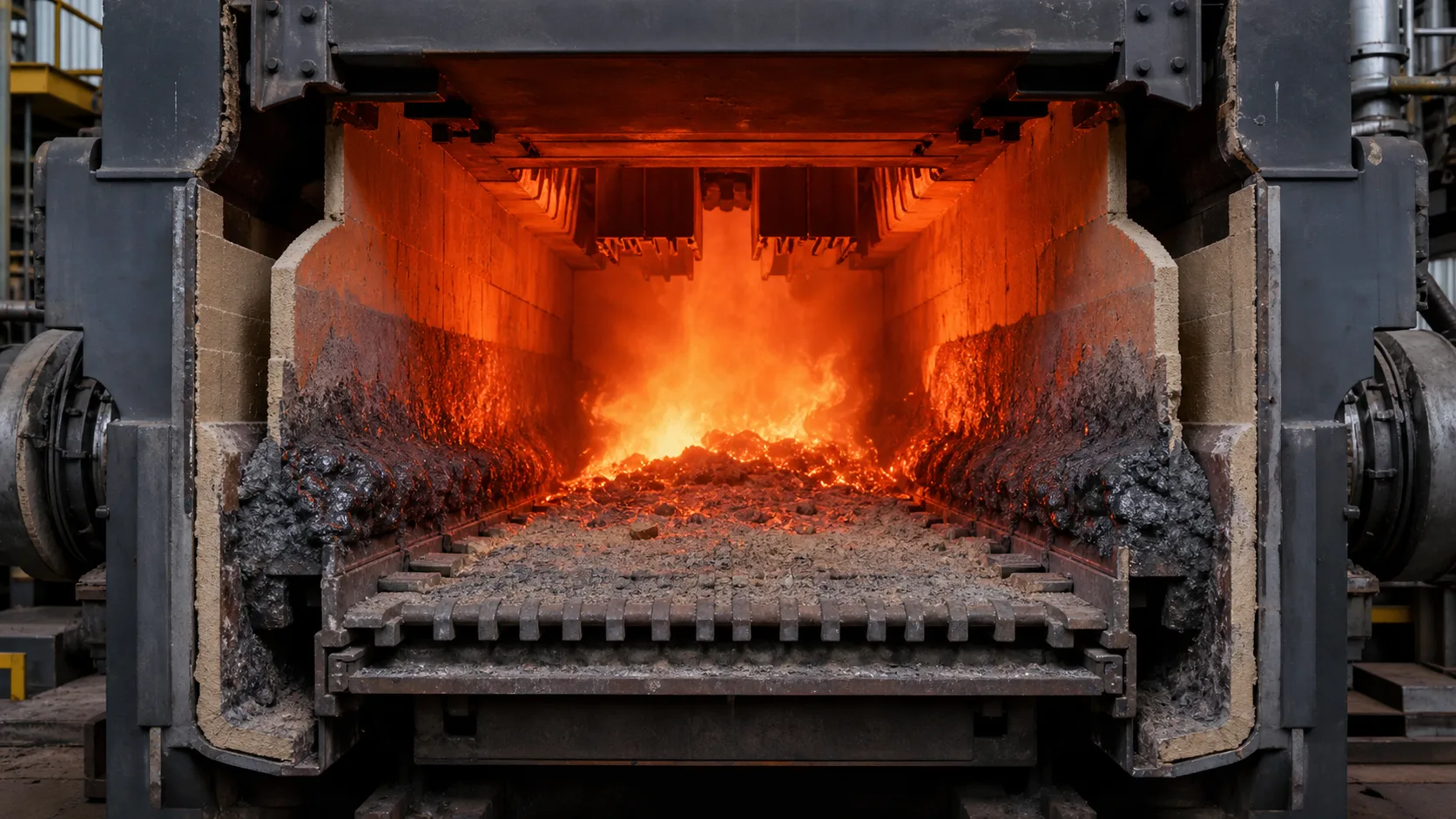
Side-wall slagging is a recurring operating problem in biomass-fired reciprocating grate boilers burning rice husk pellets. Operators typically find hard, glassy deposits growing from the grate edges upward along the refractory walls. The same units may also suffer warped grate bars, dropped side bars, severe wear-plate rubbing and refractory cracking near the lower furnace.
Fuel chemistry matters, but it is rarely the whole story. A bilateral deposit pattern—severe at both walls but lighter in the center—usually points to a local difference in fuel-bed thickness, primary-air flow or grate cooling. Rice husk ash chemistry then amplifies that local thermal imbalance.
Quick Summary
- Side-wall slagging usually begins with a local hot zone at the grate edge.
- Thin edge fuel beds, air leakage and enlarged side gaps are common triggers.
- Poor cooling can overheat and deform the same side grate bars.
- Potassium-rich rice husk ash can become sticky far below pure silica's melting point.
- Correct the combustion pattern first; removing slag alone treats only the symptom.
Typical Symptoms
Deposit Pattern
- Hard slag on both lower side walls
- Deposits climbing upward from grate level
- Loose or powdery ash toward the center
Mechanical Damage
- Warped or deformed grate bars
- Side bars dropping from supports
- Rubbing against wear plates
- Cracked lower refractory
The location of damage is useful evidence. When deformation and slagging are both strongest near the edges, investigate the local fuel-to-air ratio and mechanical clearances before blaming the entire fuel batch.
How Side-Wall Slagging Develops
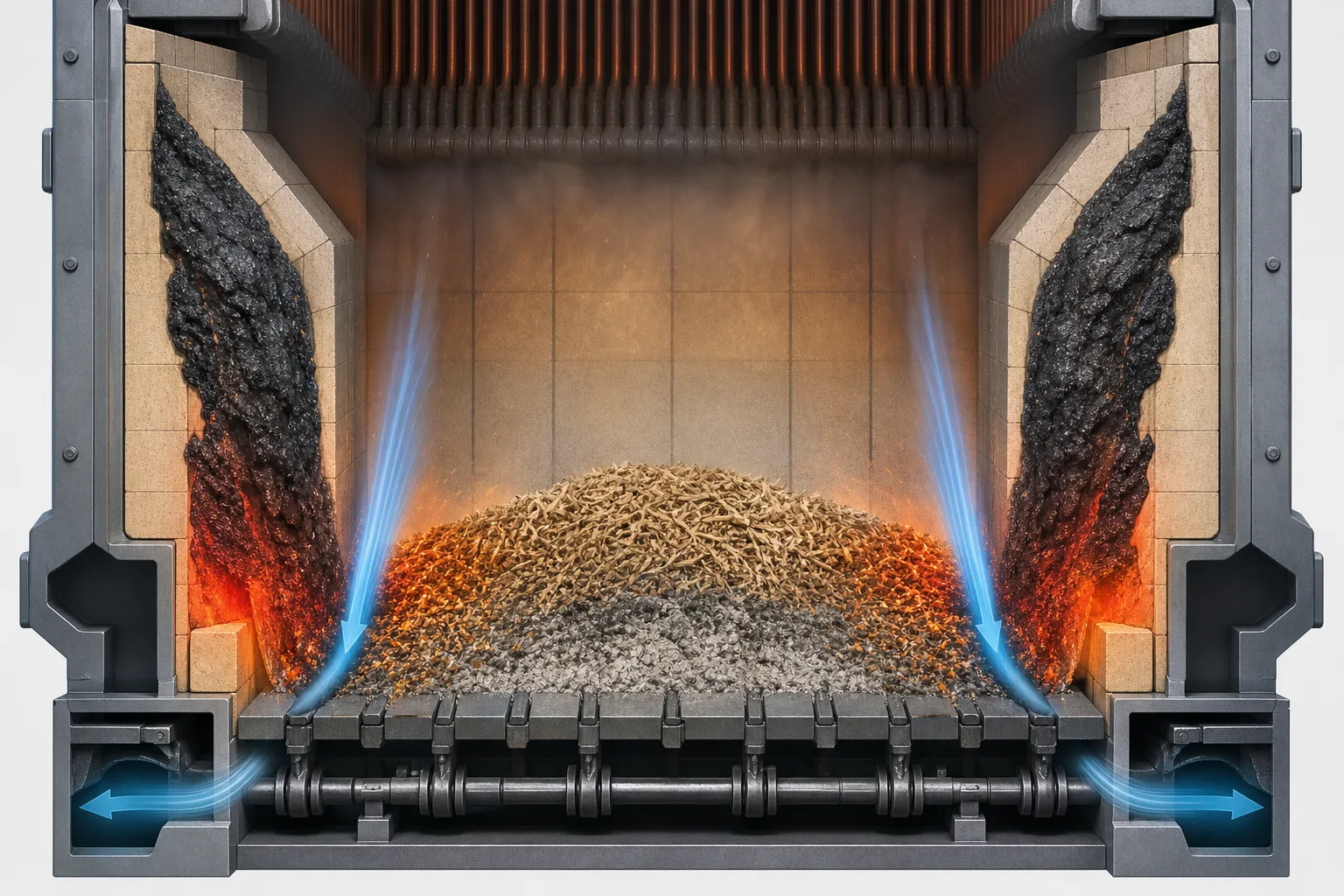
Slag growth is self-reinforcing. A small sticky layer catches new ash particles, reduces local heat loss and changes gas flow near the wall. The deposit becomes hotter and thicker, so removal intervals shorten unless the initiating condition is corrected.
1. Uneven Fuel Distribution Across the Grate
This is often the most likely root cause. If the feeder creates a thick bed in the center but a thin bed near both walls, the edge zones receive too much primary air for the available fuel. Combustion intensifies, local excess oxygen rises and the ash temperature can cross its softening range.
Strong field clue
If loose ash remains in the center while hard slag forms symmetrically at both walls, measure fuel-bed depth across the grate before changing the overall excess-air setting.
Inspect the feeder trajectory, spreader alignment, fuel segregation, bridging and any guide plates that may prevent pellets from reaching the outer grate lanes.
2. Excessive Primary Air Near the Walls
Uneven windbox pressure, enlarged wall-to-grate gaps, damaged side seals or air leakage can direct a disproportionate share of primary air into the edge zones. The result is the same: a locally lean, intense fire immediately beside the refractory.
Slag often starts at the grate-to-wall interface because this is where leakage air and exposed hot refractory meet falling ash. As the deposit grows, it can redirect airflow and make the imbalance worse.
3. Insufficient or Uneven Grate Cooling
Primary air also cools reciprocating grate bars. Blocked air holes, ash lodged between bars, an obstructed windbox or poor pressure distribution can create isolated hot spots. Overheated bars expand, warp and may lose support.
Mechanical deformation can then enlarge edge clearances, allowing even more air to bypass the fuel bed. This creates a damaging loop: poor cooling → deformation → air leakage → hotter combustion → more slagging.
4. High Lower-Wall Refractory Temperature
A healthy fuel bed shields the lower furnace from direct flame radiation. Where the edge bed is too thin, the refractory is exposed. Fine ash landing on this hot surface can soften, adhere and form the first deposit layer.
Refractory cracks, missing protection, incorrect material selection and changed burner or secondary-air patterns can further raise the local surface temperature.
5. High Potassium and Chlorine Content in Rice Husk Ash
Rice husk pellets naturally produce ash with a high silica content. Pure silica has a melting point of approximately 1,700°C, so silica alone would not normally melt under typical grate-furnace conditions. The behavior changes significantly, however, when potassium and chlorine are present.
Potassium oxide (K2O) reacts with silica to form potassium silicates. These compounds have much lower melting and softening temperatures than pure silica. Chlorine can also combine with potassium to form potassium chloride (KCl), which melts at approximately 770°C and contributes to sticky deposits and ash agglomeration.
As a result:
- The effective ash-softening range may decrease to approximately 700–900°C, depending on the actual fuel composition and furnace atmosphere.
- A local temperature increase of only 50–100°C may be enough to move the ash into a sticky or partially molten condition.
- Once the first slag layer adheres to the refractory, it traps heat, captures additional ash particles and accelerates further deposit growth.
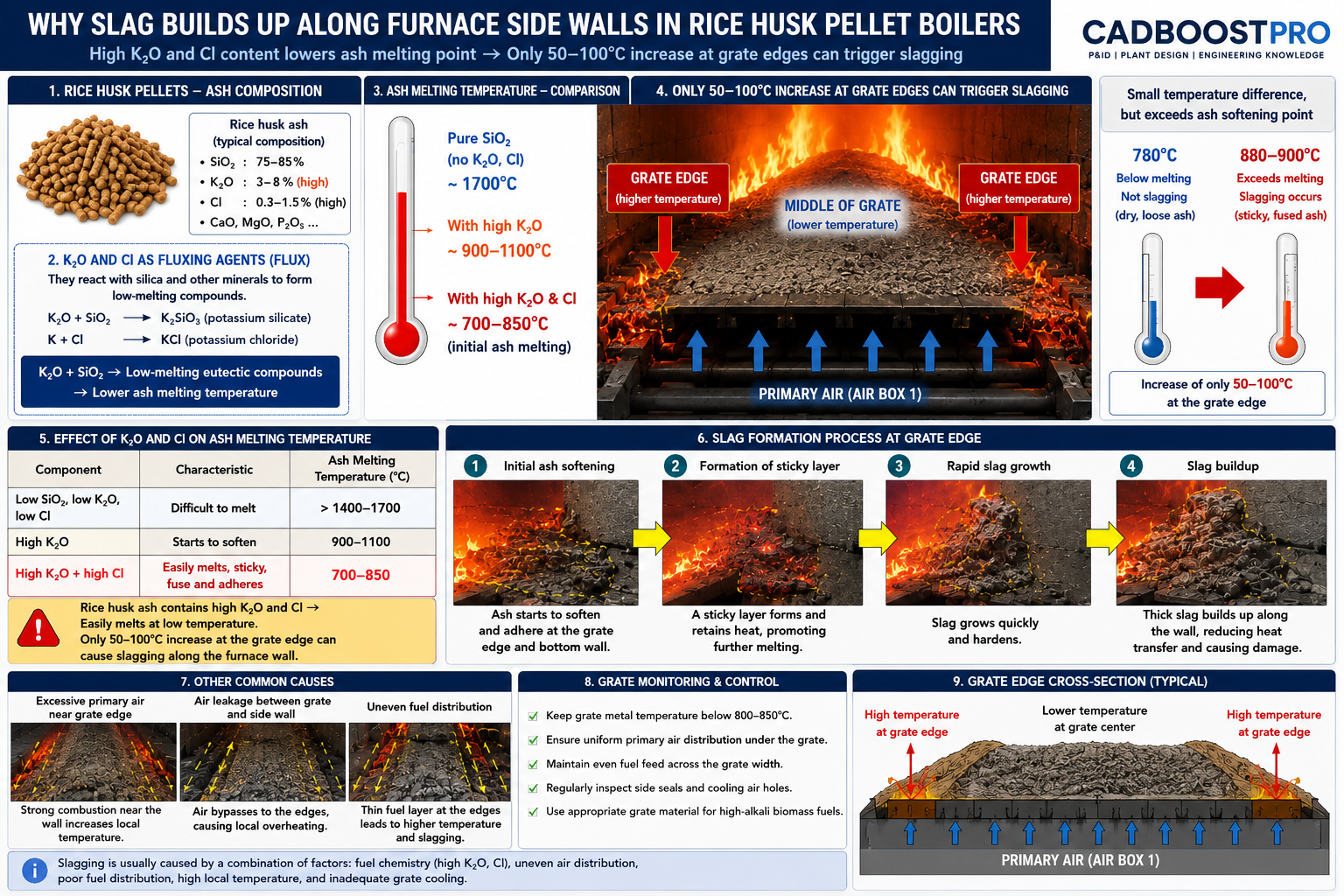
This is why rice husk ash is generally more prone to slagging than wood-pellet ash. Fuel chemistry creates the susceptibility, while uneven fuel distribution, excess side air or poor grate cooling provides the local temperature needed to initiate the deposit.
Diagnostic Guide
| Observation | Likely mechanism | First check |
|---|---|---|
| Slag on both walls; center ash loose | Thin edge bed or excessive edge air | Map fuel depth and O2/temperature across grate width |
| Warped side bars with wall slag | Poor cooling plus local overheating | Inspect air holes, windbox zones and bar clearances |
| Slag begins in grate-wall gap | Side-seal leakage or enlarged gap | Cold inspection of seals, wear plates and expansion setting |
| Sudden slagging after fuel delivery change | Changed ash chemistry or pellet properties | Compare fuel moisture, fines and ash composition |
| One wall worse than the other | Asymmetric feeder, air or refractory condition | Compare left/right bed depth, draft and mechanical alignment |
Recommended Corrective Actions
- Restore uniform fuel coverage. Adjust feeders, spreaders and guide plates so the edge zones are not starved of fuel.
- Measure before reducing total air. Compare windbox pressures, grate-zone airflow, furnace O2 and temperature across the width. The problem may be distribution, not total quantity.
- Seal bypass paths. Repair side seals, excessive grate-to-wall gaps and damaged interfaces that allow air to avoid the fuel bed.
- Recover grate cooling. Clean blocked passages and inspect air holes, bar seating, supports, expansion clearances and ash trapped between moving parts.
- Protect the lower refractory. Repair cracks and verify that refractory grade, geometry and exposure are appropriate for the actual furnace conditions.
- Check fuel and ash quality. Trend moisture, fines, ash content, alkali/chlorine content and ash-fusion behavior by supplier or batch.
- Review grate metallurgy. If temperatures are controlled but deformation continues, confirm alloy grade and component design with the grate supplier.
Common Troubleshooting Mistakes
Removing deposits without finding the hot zone
Cleaning restores space temporarily, but slag returns quickly if fuel and air distribution remain unchanged.
Reducing all primary air at once
A blanket reduction may worsen burnout and carbon loss. Correct the edge-to-center distribution first.
Changing several variables simultaneously
Adjust one operating factor at a time and record bed profile, O2, temperatures, draft and slag growth so the effective change can be identified.
Frequently Asked Questions
Is rice husk pellet quality the only cause of slagging?
No. Fuel chemistry controls susceptibility, while local fuel distribution, air leakage, cooling and refractory temperature often determine where slag first forms.
Why is the center clean while both side walls slag?
The pattern usually indicates that the edge zones are leaner or receive more bypass air. Their local temperature can exceed the ash-softening range even when average furnace conditions look acceptable.
Can high primary-air temperature make the problem worse?
Yes, it can reduce grate-cooling margin and raise local combustion temperature. However, distribution and ash chemistry should be investigated alongside air temperature.
What should be checked during the next shutdown?
Document deposit thickness and location before cleaning, then inspect side seals, bar gaps, air holes, wear plates, supports, expansion clearances and lower-wall refractory.
Conclusion
Side-wall slagging in rice husk pellet reciprocating grate boilers is normally a combined combustion and mechanical problem. Uneven fuel distribution or bypass air creates the local hot zone; insufficient cooling and refractory exposure sustain it; potassium-rich ash makes deposits possible at operating temperatures.
The most effective response is therefore systematic: read the deposit pattern, measure conditions across the grate, repair air and mechanical defects, then confirm the fuel's ash behavior. That approach reduces both slag formation and the grate damage that often accompanies it.