Why the Fuel Is Often the First Place to Look
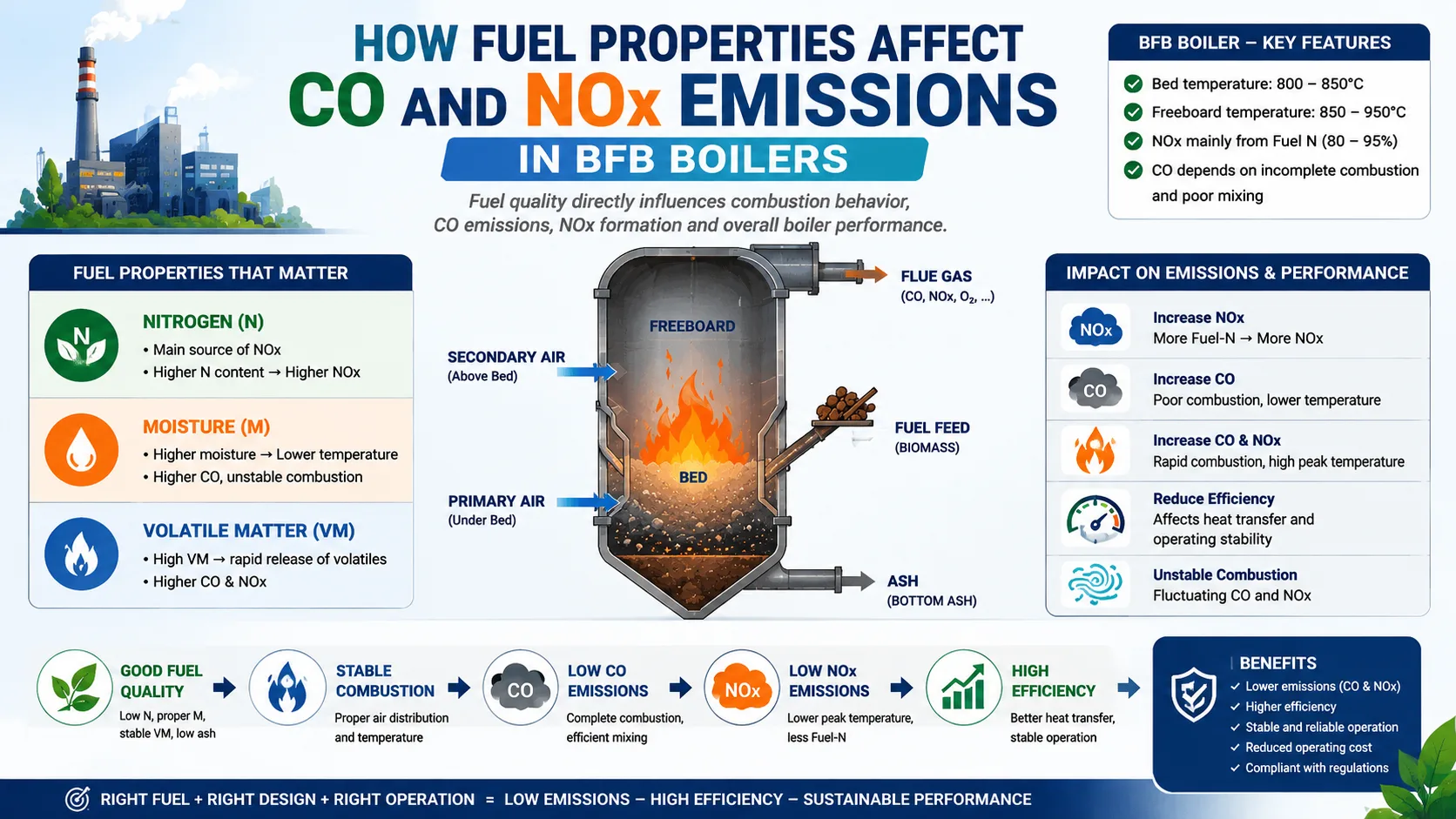
When carbon monoxide or nitrogen oxides rise in a bubbling fluidized bed (BFB) boiler, the first response is often to adjust excess oxygen, secondary air or bed temperature. Those controls matter, but they act on a combustion process whose starting conditions are set by the fuel. A new biomass delivery can change fuel-bound nitrogen, moisture, volatile matter, ash, heating value and particle-size distribution at the same time. The boiler may then produce different emissions even though its control setpoints have not moved.
CO is mainly evidence of incomplete oxidation. It rises when combustible gases or char do not receive the right combination of oxygen, temperature, mixing and residence time. Wet or oversized fuel can cool the bed and delay burnout. Highly volatile fuel can release gases faster than secondary air can mix with them. High ash content dilutes the combustible portion and can disturb bed behavior or heat transfer.
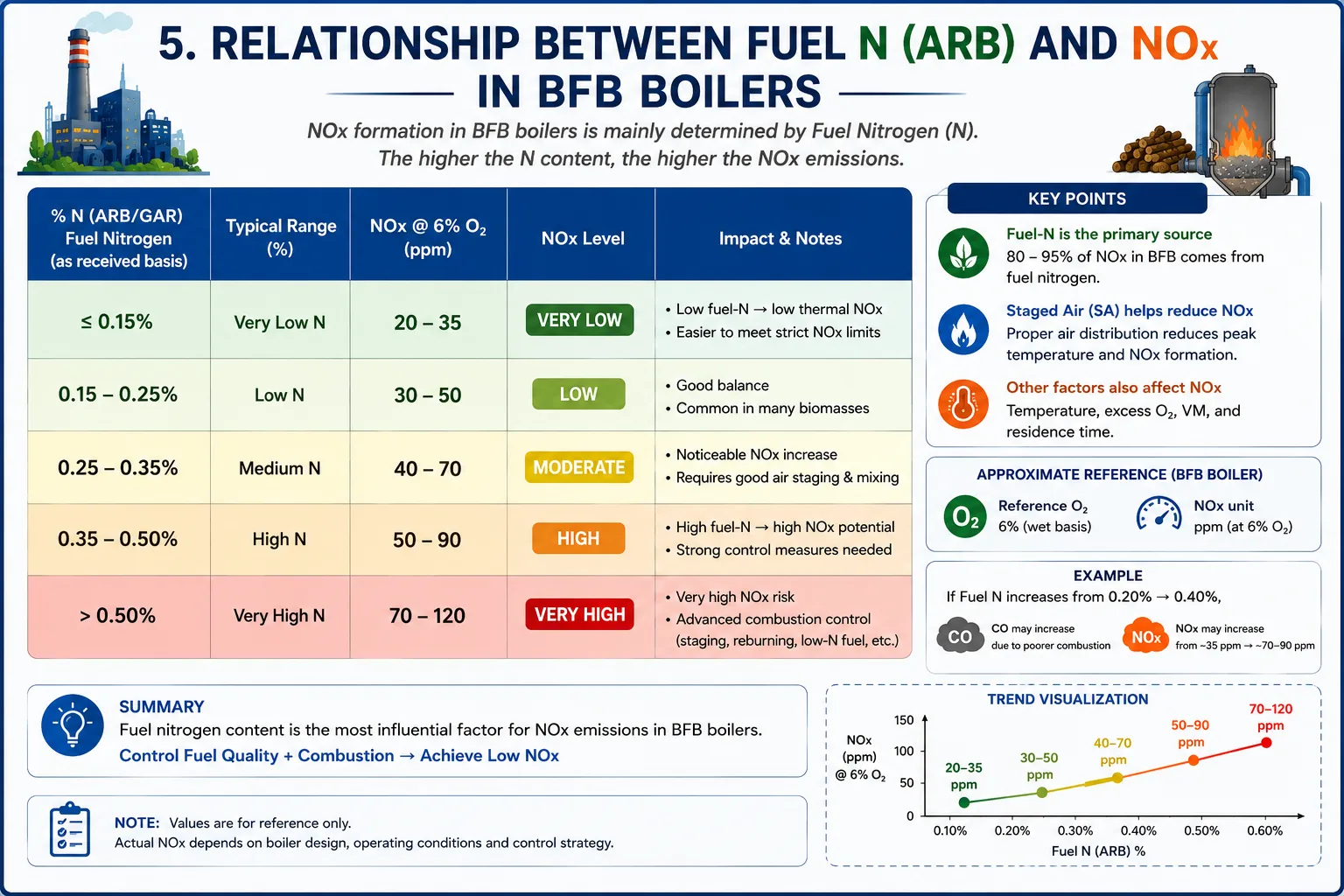
NOx in a biomass BFB is governed mainly by fuel nitrogen and its conversion environment. BFB bed temperatures are normally too low for thermal NOx to dominate, so nitrogen released from the biomass as volatile species and char-N becomes the principal source. Yet a higher nitrogen analysis does not translate into one fixed NOx value: oxygen availability, air staging, temperature, residence time, char inventory and gas–solid reactions determine how much fuel-N becomes NO rather than N2 or other nitrogen species.
The useful diagnostic question is therefore not simply “Is the fuel good or bad?” It is: which property changed, which combustion mechanism did it alter, and what operating response followed? Reading fuel analysis together with boiler trends makes that chain visible and prevents operators from treating every emission excursion as an air-control problem.
Quick Answer
- Higher fuel nitrogen generally increases NOx potential.
- Higher moisture usually increases CO when it lowers temperature or slows burnout; NOx may decrease or remain similar.
- High volatile matter can improve ignition but cause CO peaks when volatile release outruns air mixing.
- Ash affects emissions indirectly through fuel dilution, heat transfer, bed inventory and deposits.
- Particle size and heating value determine how quickly and where heat is released.
Why Fuel Properties Change Emissions
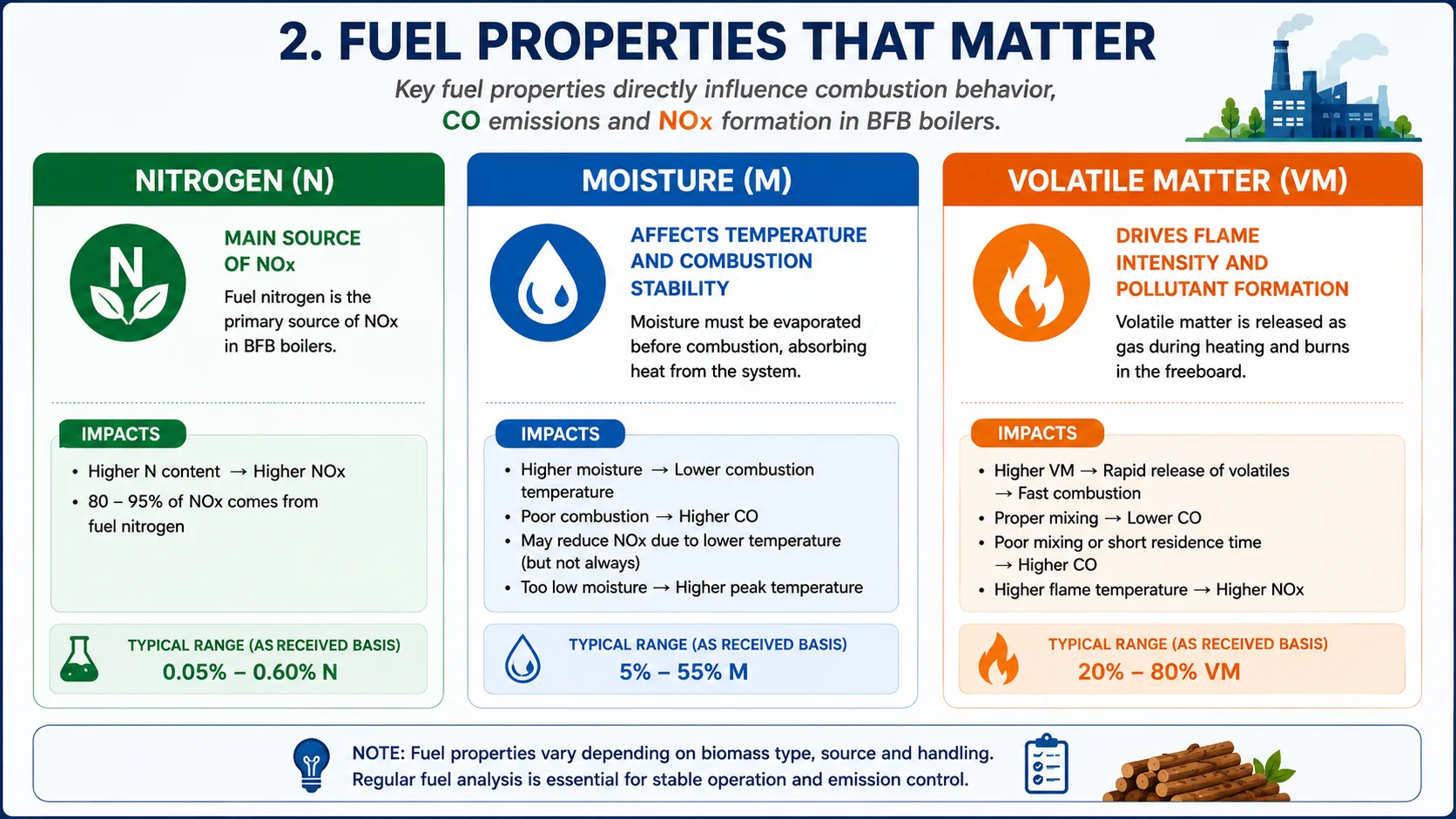
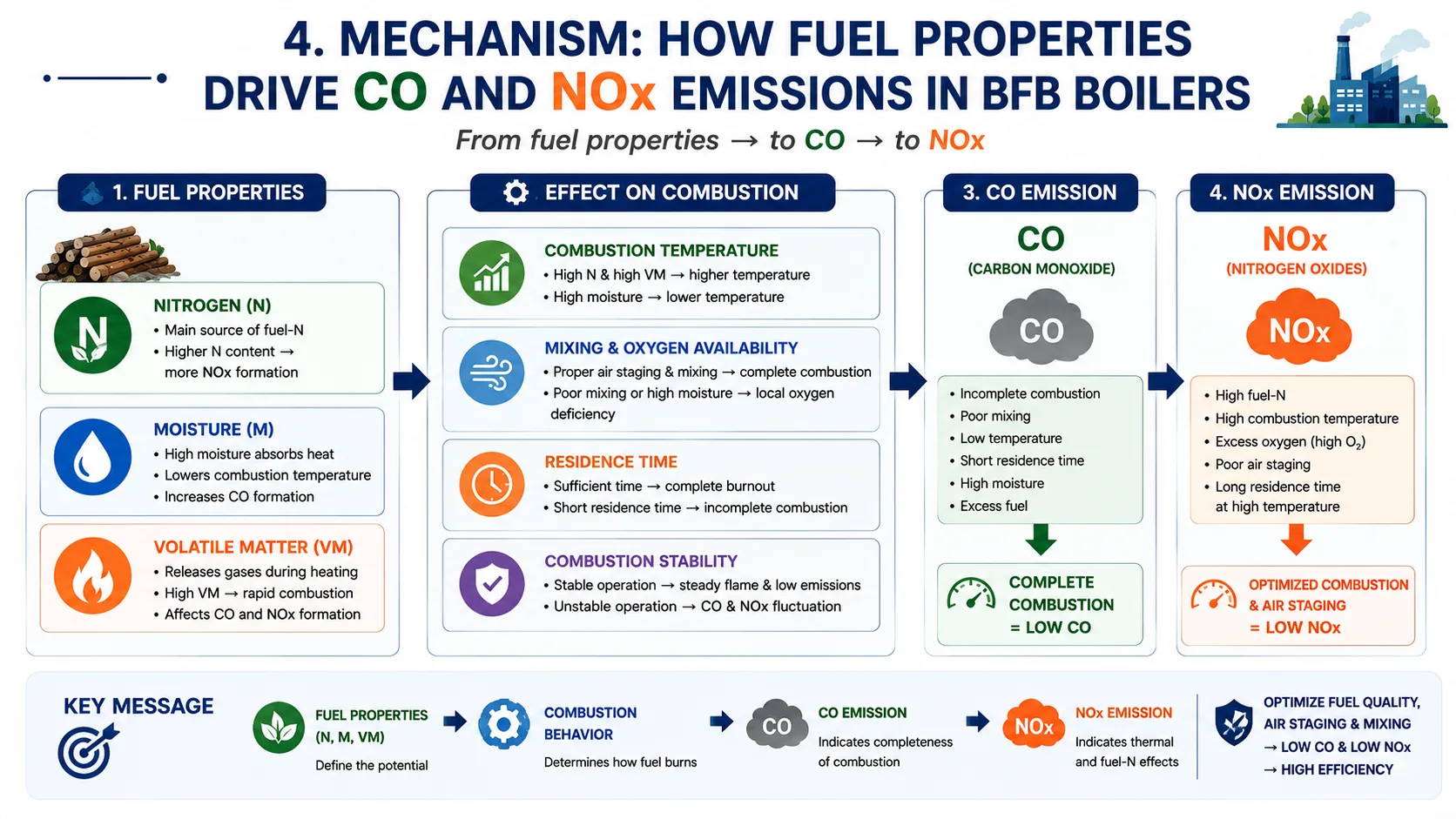
Fuel properties do not act on the stack analyzer directly. They change drying, devolatilization, char combustion and heat release inside the furnace. Those changes then alter local temperature, oxygen concentration, mixing and residence time—the conditions that govern CO oxidation and fuel-nitrogen conversion.
This is why two fuels with the same lower heating value can still produce different emissions. Their nitrogen distribution, moisture, volatile release and ash chemistry may create very different reaction histories inside the bed and freeboard.
Where Emissions Form in a BFB Boiler
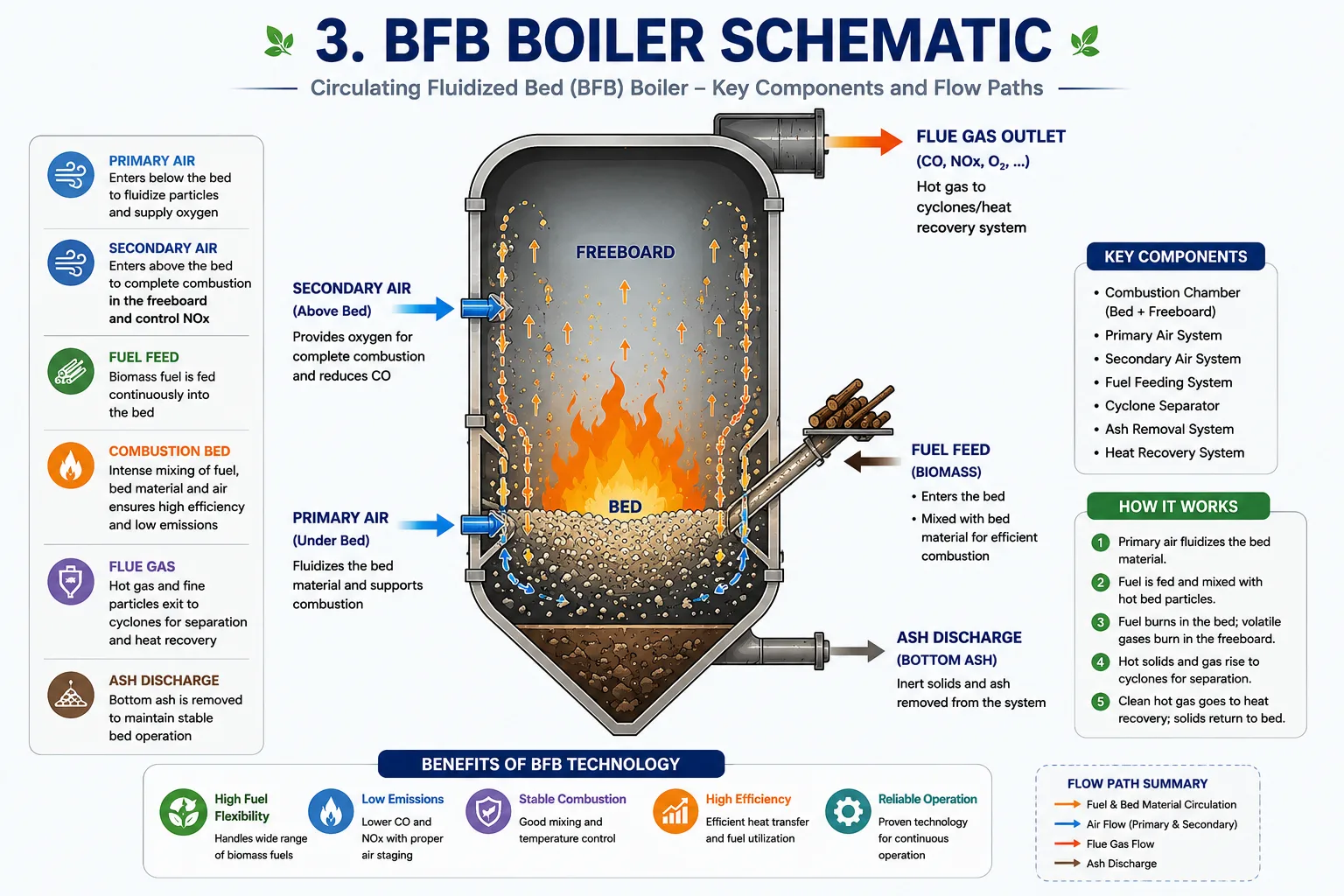
Primary air enters below the distributor and fluidizes the bed material. Fuel dries, heats and begins devolatilizing near the feed zone. Char remains in or near the bed, while volatile gases move into the freeboard and mix with secondary air. CO can originate in both zones, but final burnout depends heavily on freeboard temperature, mixing and residence time. Fuel-N is released partly with the volatiles and partly through char conversion, creating competing pathways toward NO, N2O and molecular nitrogen.
A stack reading is therefore the integrated result of many local environments. Average O2 can look acceptable while fuel-rich pockets generate CO, or while oxygen-rich regions convert more nitrogen intermediates to NO.
1. Fuel Nitrogen: The Main Driver of NOx Potential
Fuel nitrogen is organically bound nitrogen measured in the ultimate analysis, normally reported as a mass percentage on an as-received, dry or dry-ash-free basis. Always compare values on the same basis. Even a small difference in percentage can materially change the nitrogen input when a boiler burns many tonnes of fuel per hour.
Fuel NOx
During devolatilization, part of the nitrogen leaves with volatile compounds that form intermediates such as NH3 and HCN. Nitrogen remaining in char follows a separate conversion route. In oxygen-rich regions, these intermediates can oxidize to NO; under fuel-rich staged conditions, they can also participate in reactions that form N2 or reduce existing NO.
Thermal and prompt NOx
Thermal NOx forms from atmospheric nitrogen at very high flame temperatures. Because BFB combustion commonly operates around 750–900°C, this pathway is usually much less important than in a high-temperature pulverized-fuel flame. Prompt NOx, created through hydrocarbon-radical reactions in fuel-rich flame fronts, is also generally secondary in a biomass BFB. Consequently, fuel-derived nitrogen is normally the dominant origin of NOx, but its conversion percentage varies with fuel and operating conditions.
Do not use “80–95%” as a universal conversion factor
It is reasonable to say that most NOx in a low-temperature biomass BFB is fuel-derived. It is not reasonable to assume that 80–95% of the nitrogen contained in the fuel becomes stack NOx. Only a fraction converts to NOx, and that fraction changes with air staging, oxygen, temperature, residence time and fuel chemistry.
2. Moisture: A Heat Sink That Can Raise CO
Water entering with biomass must be heated and evaporated before the particle can reach effective devolatilization and char-combustion temperatures. If the boiler cannot compensate for this additional heat demand, higher moisture lowers local temperature, delays ignition and shortens the effective burnout time. CO then rises because oxidation becomes slower or incomplete.
Lower temperature can reduce NO formation in some conditions, so NOx may fall or remain broadly unchanged while CO rises. However, moisture is not an independent NOx-control method: additional wet fuel increases flue-gas flow, reduces efficiency and can destabilize combustion. The result also depends on whether the control system adds fuel or air to maintain load.
3. Volatile Matter: Fast Release Requires Fast Mixing
Biomass usually contains a high fraction of volatile matter. This supports rapid ignition and can improve burnout when secondary air mixes effectively with the released gases. The same property becomes a liability when devolatilization is concentrated near the feed point or occurs faster than oxygen can penetrate the gas plume. Fuel-rich pockets then carry CO and hydrocarbons through the freeboard.
Volatile matter also controls how much nitrogen is released into the gas phase and where that release occurs. NOx can increase when volatile-N meets abundant oxygen, or decrease when staged, fuel-rich regions promote reduction to N2. For this reason, “higher volatile matter means higher NOx” is too simple; volatile release and air-distribution patterns must be considered together.
4. Ash Content: Mostly an Indirect Emission Effect
Ash is non-combustible material, so higher ash content lowers the useful energy per kilogram of as-fired fuel and may require a higher mass feed rate for the same boiler load. Ash can alter bed inventory, particle circulation and heat transfer. Deposits on heating surfaces can change furnace temperature, while agglomeration or poor ash removal can disturb fluidization and create zones with weak mixing.
Those effects tend to increase CO when combustion becomes colder or less uniform. The direction of the NOx response is less predictable because mineral matter can influence nitrogen reactions and because operators may compensate with different air or temperature settings. Ash content alone is therefore a weak NOx predictor; ash chemistry and its operational consequences are more informative.
5. Fuel Size and Heating Value
Particle Size
Fine particles heat and devolatilize quickly and may be carried into the freeboard before complete burnout. Oversized or dense particles dry and burn slowly, increasing unburned carbon and CO risk. A broad size distribution can make heat release less uniform.
Heating Value
Low as-fired heating value—often associated with moisture or ash—requires more fuel for the same load. High heating value can produce intense local heat release if feed and air distribution are not matched. Stability matters as much as the absolute value.
Summary: Expected Direction of Change
| Fuel property increases | Typical CO response | Typical NOx response | Why |
|---|---|---|---|
| Fuel nitrogen | Usually little direct effect | Increases in general | More fuel-N is available for conversion, although conversion efficiency varies. |
| Moisture | Often increases | May decrease or remain similar | Evaporation cools combustion and slows burnout. |
| Volatile matter | May decrease or increase | Condition-dependent | Ignition improves, but rapid gas release can outrun secondary-air mixing. |
| Ash content | Can increase | Variable | Fuel dilution, bed behavior and heat-transfer changes affect combustion indirectly. |
| Particle size | Optimum range required | Indirect effect | Very fine and very coarse fractions create different burnout problems. |
| Heating value | Depends on control response | Depends on heat release | Changes fuel feed rate, local temperature and air demand. |
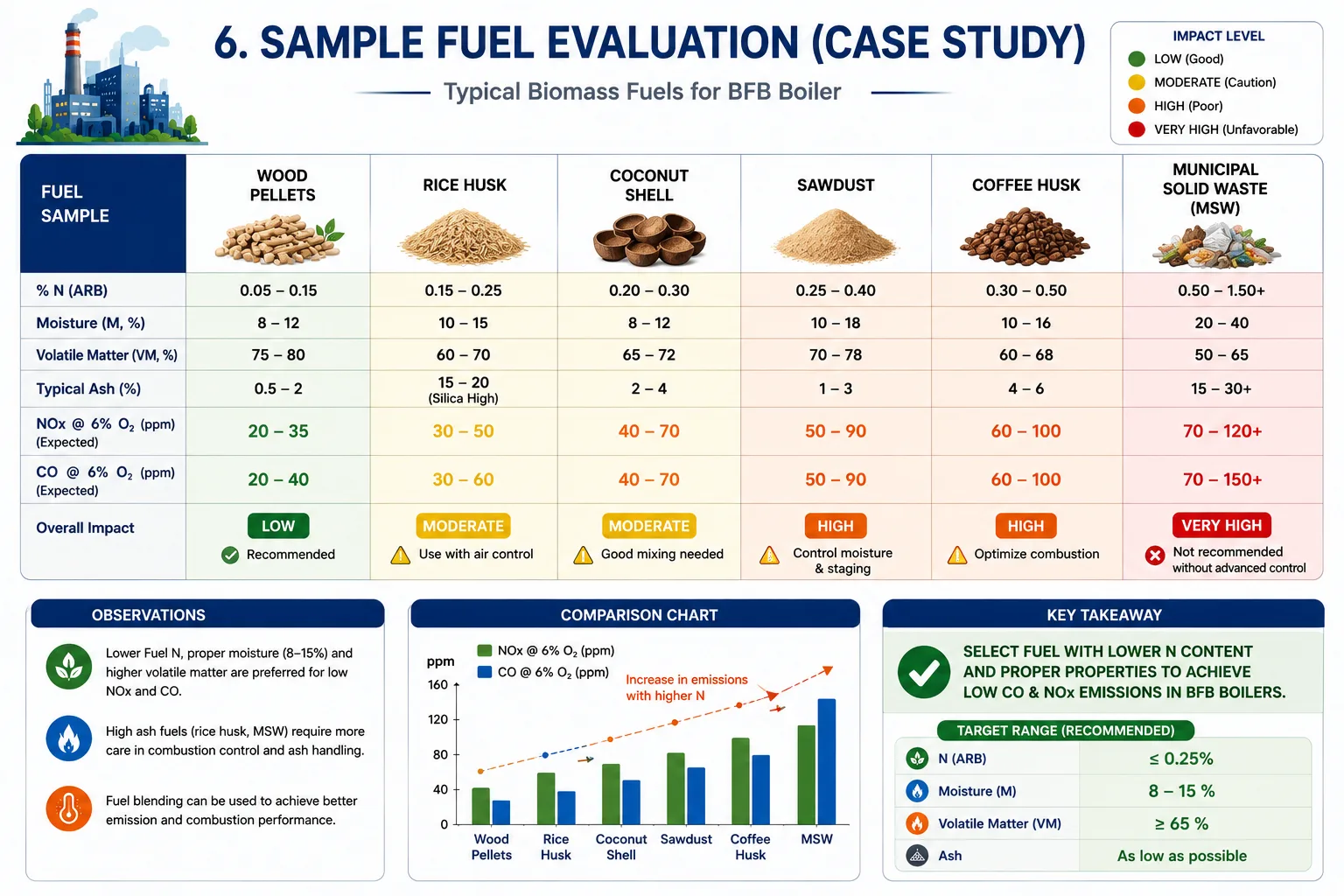
Illustrative Fuel Comparison
| Parameter | Pellet A | Pellet B |
|---|---|---|
| Fuel nitrogen, dry basis | 0.18% | 0.42% |
| Moisture, as received | 10% | 15% |
| Volatile matter, dry basis | 75% | 70% |
| Illustrative NOx | 35 ppm | 80 ppm |
| Likely interpretation | Lower fuel-N input and easier ignition | Higher NOx potential plus greater drying demand |
These are teaching values, not a fuel guarantee
The example does not predict emissions from analysis alone. A valid plant comparison must use the same load, oxygen reference, dry/wet basis, pressure reference and averaging period. Record CO and NOx with O2, bed/freeboard temperatures, fuel rate and primary/secondary-air settings.
Fuel Selection and Operating Recommendations
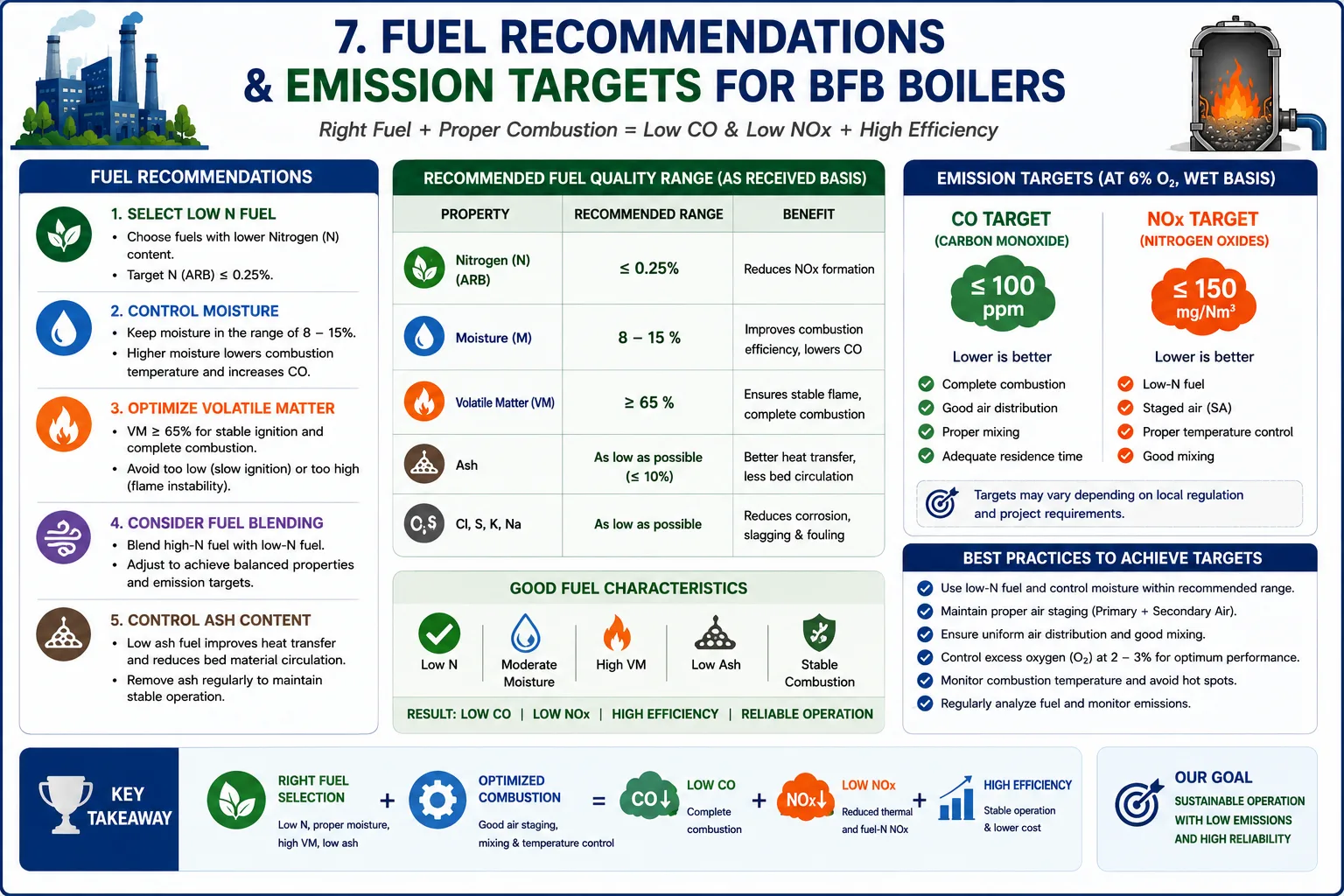
- Specify a consistent fuel-nitrogen limit and compare laboratory results on the same reporting basis.
- Control moisture within a practical range that the furnace and fuel-handling system can tolerate.
- Monitor volatile matter together with secondary-air distribution and freeboard CO.
- Set maximum ash content and investigate ash chemistry where deposits or agglomeration affect fluidization.
- Screen excessive fines and oversized pieces; trend particle-size distribution by supplier.
- Normalize emission data before comparing fuels. Record ppm on a defined dry basis and reference O2, or use an agreed mass-per-energy unit.
- Run a controlled fuel trial before changing several combustion setpoints at once.
Frequently Asked Questions
Why does high fuel nitrogen increase NOx?
Fuel-bound nitrogen is released during devolatilization and char combustion, forming intermediates such as NH3 and HCN. In oxygen-rich regions, part of these compounds oxidizes to NO. Higher fuel nitrogen therefore increases NOx potential, although the final conversion depends on oxygen, air staging, temperature, residence time and char reactions.
Does high moisture always reduce NOx?
No. Moisture can lower combustion temperature and reduce NO formation under some conditions, but it can also destabilize combustion, increase CO and cause the control system to add more fuel or air. The final NOx response depends on boiler load, fuel-nitrogen input and operating controls.
What is the optimum moisture for wood pellets?
There is no universal optimum for every BFB boiler. A practical as-received range of roughly 6–12% is common for industrial wood pellets, provided the fuel remains mechanically durable and the boiler is designed for it. The boiler supplier's fuel specification and stable operating data should determine the final limit.
Can SNCR compensate for high fuel nitrogen?
SNCR can reduce the NOx formed from a high-nitrogen fuel, but it cannot remove the underlying fuel-nitrogen input. Performance is limited by furnace temperature, reagent mixing, residence time and ammonia-slip constraints. Fuel selection and combustion optimization should come before increasing reagent demand.
Conclusion
Reducing BFB emissions does not begin only with excess-air tuning or an SNCR system. It begins with understanding the fuel entering the furnace. Low and consistent fuel nitrogen reduces NOx potential; controlled moisture supports temperature and burnout; predictable volatile matter, ash, heating value and particle size make air distribution easier to match to the actual combustion process.
No single fuel specification guarantees a stack result because the boiler determines how fuel properties are converted into emissions. The strongest approach combines consistent purchasing limits with normalized emissions data and time-aligned operating trends. That turns CO and NOx from isolated analyzer numbers into useful evidence about drying, devolatilization, mixing and fuel-nitrogen conversion inside the BFB.