Introduction: Fuel Size Is a Combustion-Control Variable
In the design and operation of a bubbling fluidized bed (BFB) boiler, many discussions start with combustion air flow, bed temperature and excess O2. Those variables are important, but they do not act on an empty furnace. They act on a stream of real biomass particles entering the bed with a specific diameter, length, density, moisture and mechanical durability.
In practice, biomass fuel particle size can decide where combustion begins, how fast volatile matter is released, how long char remains in the bed and whether the final stack reading shows stable CO and NOx. A fuel with the same ultimate analysis can behave very differently if it arrives as fine dust, controlled pellets or oversized pieces. This is why particle size should be treated as a design and operation parameter, not only as a purchasing detail.
This article explains the mechanism from the viewpoint of BFB boiler design and field operation. The focus is not only whether a particle is "small" or "large", but how its size changes heating rate, devolatilization, char combustion and residence time inside the fluidized bed and freeboard.
Quick Answer
- Excessive fines can ignite fast but leave the bed too early, increasing freeboard CO if mixing is weak.
- Oversized particles dry and burn slowly, increasing char carryover, unburned carbon and CO risk.
- A broad size distribution creates uneven heat release and unstable local oxygen demand.
- NOx changes indirectly through volatile-N release, char-N conversion, oxygen availability and temperature.
- The best fuel size is not universal; it must match the BFB design and fuel-handling system.
Fines
Fast heating, high entrainment risk and short effective residence time.
Controlled Range
More predictable drying, devolatilization, char burnout and air demand.
Oversized
Slow internal heating, delayed burnout and higher unburned-carbon risk.
1. Why Fuel Particle Size Is Important
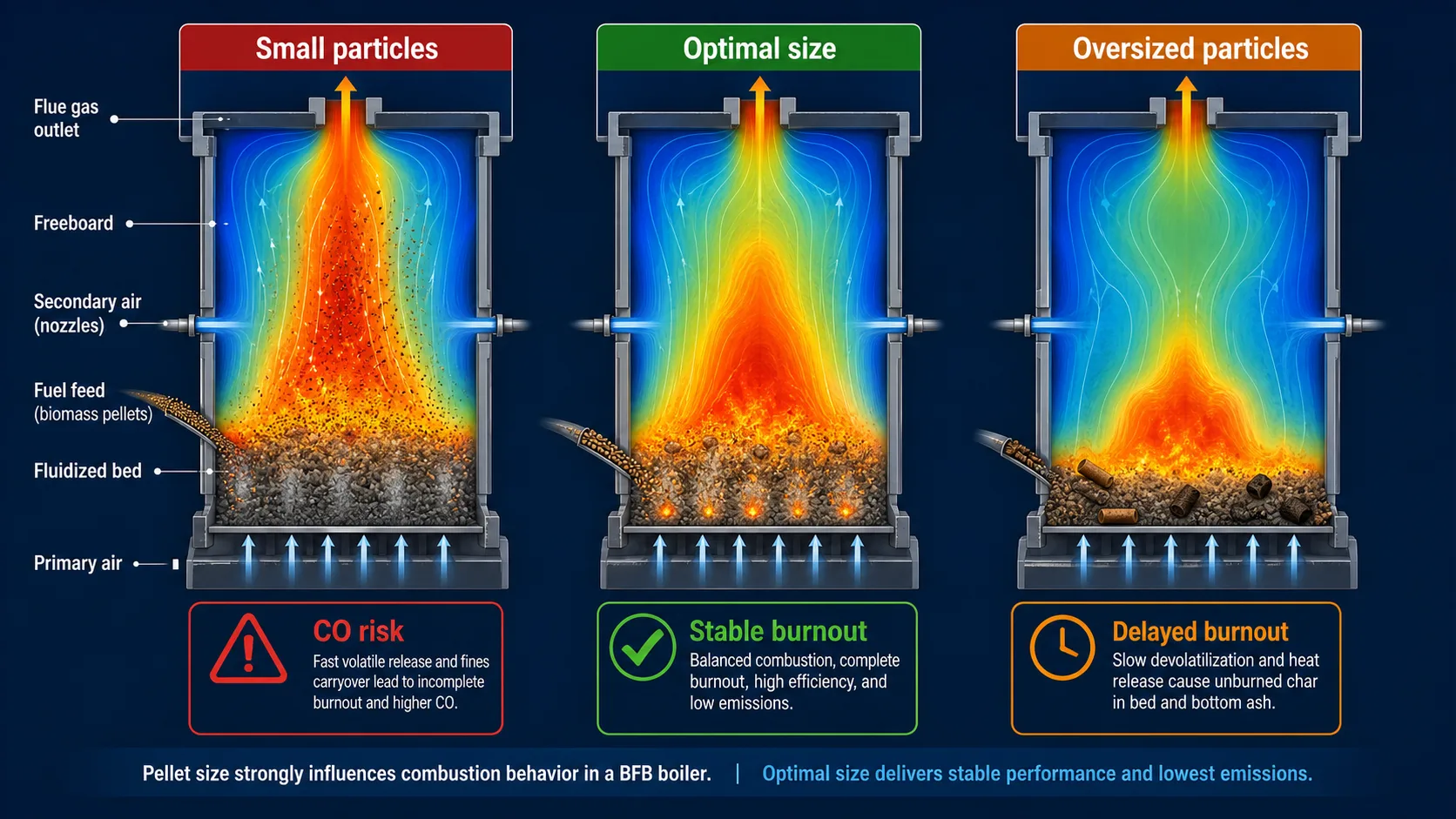
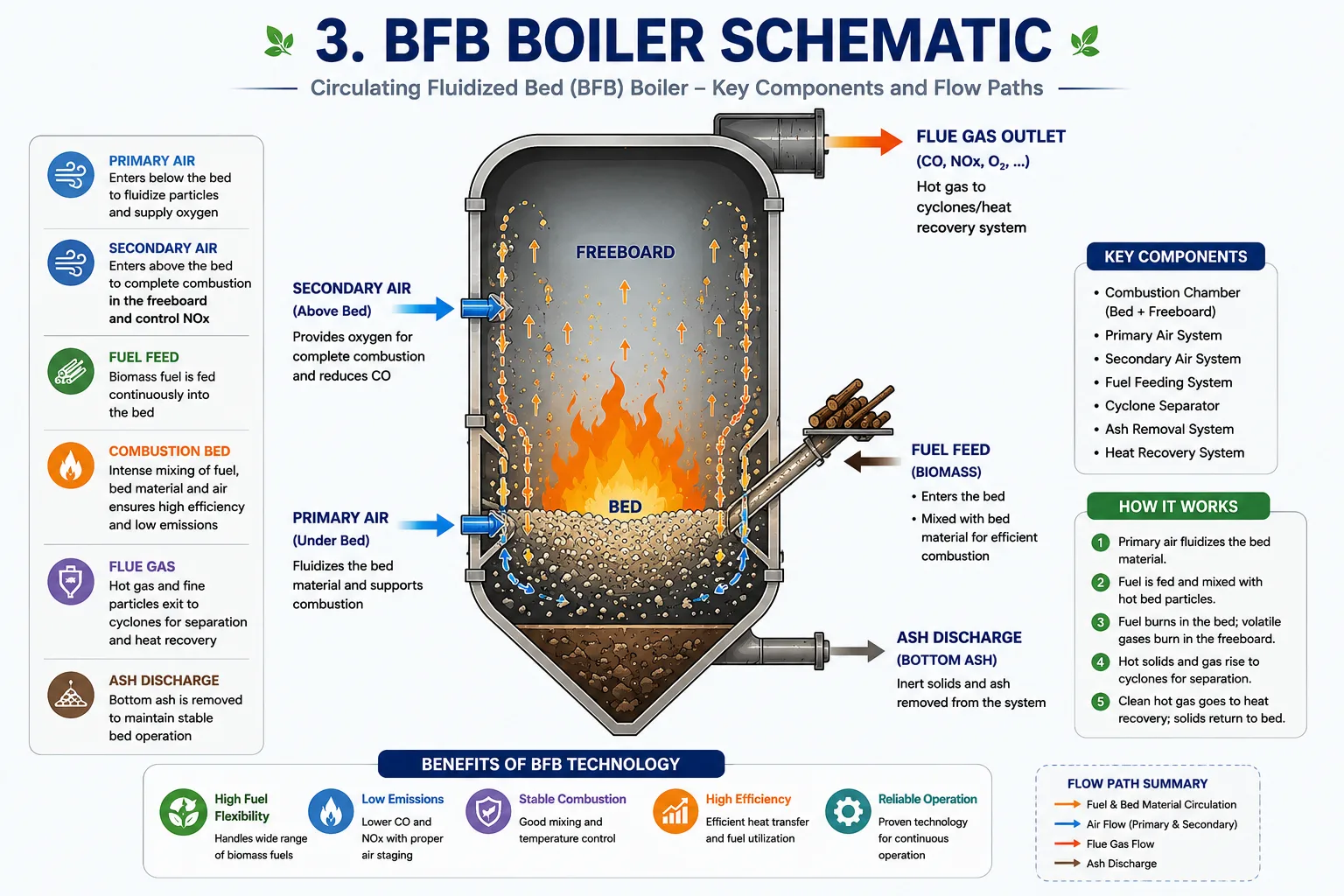
A biomass particle entering a BFB boiler must pass through drying, heating, devolatilization and char combustion. Particle size affects every step because heat travels from the particle surface toward the interior. Small particles heat quickly, release volatiles early and may be carried upward before complete burnout. Large particles heat slowly, release volatiles later and may leave unburned char in the bed or bottom ash.
The most useful way to think about particle size is residence time. A BFB boiler needs enough time for moisture evaporation, volatile release, gas-phase oxidation and char burnout. If the particle burns too fast in the wrong location, CO can slip through the freeboard. If it burns too slowly, unburned char and delayed heat release can create high CO, unstable O2 and poor efficiency.
2. When the Fuel Is Too Small
Small pellets and fines are common in biomass handling systems. Pellets may be designed at around 4-6 mm diameter, but storage, conveying, screening and repeated handling can create a fine fraction below the intended size. At first glance, small particles look attractive because they heat quickly and ignite easily. For a cold or unstable furnace, that fast ignition can help.
The disadvantage is that small particles have low mass and high surface area. They can release volatiles very quickly near the fuel feed point, creating a short zone of high oxygen demand. They can also be entrained by primary air and freeboard gas flow before char burnout is complete. When this happens, CO does not rise because the fuel is hard to ignite; it rises because the fuel leaves the best burnout zone too soon.
Fine particles can also disturb NOx behavior. Rapid volatile release brings volatile-N into the freeboard earlier. If secondary air creates oxygen-rich pockets, more nitrogen intermediates can oxidize to NO. If staging is strong and residence time is sufficient, some fuel-N may instead be reduced toward N2. This is why small fuel does not have one fixed NOx effect.
Small is not always cleaner
Grinding biomass smaller does not automatically reduce CO. The boiler must still provide enough residence time, oxygen contact and freeboard mixing for the released gases and char fines to finish burning.
3. When the Fuel Size Is Close to Optimum
An optimum size range is not a universal number, but a good BFB fuel normally gives predictable feeding, stable bed inventory and enough residence time for complete burnout. For many industrial pellet applications, a practical starting point is a pellet diameter around 6-8 mm with a controlled length, often in the range of 10-30 mm, provided the boiler supplier has designed the feeding and air system for that fuel.
In the optimum range, fuel particles dry and devolatilize inside the intended combustion region. Volatile gases rise into the secondary-air zone with enough turbulence and residence time for burnout. Char remains long enough in the bed to complete oxidation without excessive carryover. The result is not only lower CO, but also more stable O2, bed temperature and boiler load control.
This is the operating condition designers are looking for: heat release is distributed, not concentrated; air demand is predictable, not pulsing; and the freeboard completes combustion rather than trying to recover from poor fuel preparation.
4. When the Fuel Is Too Large
Oversized pellets, chips or dense biomass pieces create the opposite problem from fines. They need longer heating time and may continue releasing volatiles later than expected. Their core can remain wet or only partially devolatilized while the outer layer is already burning. This delays char conversion and can leave unburned material in bottom ash.
When oversized fuel is common, operators may see higher CO, higher loss on ignition, more bottom ash carbon and larger bed-temperature swings. The control room may respond by increasing excess air, but more air does not always solve the root cause. It can cool some regions, raise fan power and create oxygen-rich zones while large particles still burn slowly.
Oversized fuel may also increase NOx indirectly. If operators add more air to chase CO, parts of the furnace become more oxidizing. If bed temperature rises locally around delayed char combustion, fuel-N conversion can shift. The result is often a plant that has both poor efficiency and difficult NOx control even though the air-flow readings appear to be within design limits.
5. Broad Size Distribution: The Hidden Instability
A narrow, stable size distribution is easier to control than a mixed stream of dust, normal pellets and oversized pieces. Fines release heat early and may travel high into the furnace. Oversized pieces release heat late and remain active near the bed or ash discharge. The air system then has to serve two different combustion histories at the same time.
What Operators Notice
CO spikes, unstable O2, changing bed temperature, uneven ash carbon and inconsistent response after air adjustments.
What To Check
Fuel screening data, feeder segregation, dust generation, crushed pellets, oversized pieces, moisture variation and supplier changes.
6. Mechanism of CO Formation
CO forms when carbon-containing gases or char do not receive the correct combination of oxygen, temperature, mixing and residence time. Particle size affects all four. Fines can create rapid volatile clouds that outrun secondary-air mixing. Oversized particles can release combustible gases too late or leave char that does not finish burning before ash discharge.
In a well-tuned BFB, CO should be controlled by stable bed temperature, good secondary-air penetration and enough freeboard residence time. If fuel size changes suddenly, the same air settings may no longer match the combustion pattern. This is why a boiler can show acceptable O2 but still produce CO peaks: average oxygen is present, but it is not reaching the right combustible species at the right time.
7. Mechanism of NOx Formation
In biomass BFB boilers, NOx is commonly dominated by fuel nitrogen rather than thermal NOx because typical bed temperatures are far below the flame temperatures where thermal NOx dominates. Particle size does not increase the nitrogen percentage in the fuel, but it changes the environment where fuel nitrogen is released and converted.
Fine particles release volatile-N quickly. If this release meets oxygen-rich secondary air, more nitrogen intermediates such as NH3 and HCN can oxidize toward NO. If the same release happens in a staged, fuel-rich region, some nitrogen may be reduced toward N2. Oversized particles shift part of the nitrogen release into slower char-related pathways. Depending on oxygen, temperature and char inventory, that can either suppress or increase measured NOx.
The practical conclusion is simple: particle size is not a fixed NOx knob. It is a combustion-pattern knob. Use NOx trends together with CO, O2, bed temperature and fuel screening data to understand whether the size change improved or damaged the actual reaction environment.
8. Practical Results and Field Interpretation
| Pellet size condition | CO | NOx | Efficiency | Main operating reason |
|---|---|---|---|---|
| Too small / many fines | Low to high | Variable | Medium | Fast volatile release and carryover can reduce effective burnout time. |
| Optimum range | Low | Low / stable | High | Balanced drying, devolatilization, char burnout and air mixing. |
| Too large / oversized | Often high | Can increase | Low | Slow heating and delayed burnout increase unburned carbon and excess-air demand. |
| Very wide distribution | Unstable | Unstable | Low to medium | The bed receives both early and late heat-release patterns at the same time. |
CADBoost Design Experience
In BFB projects and boiler-performance reviews that CADBoost engineering teams participate in, non-uniform pellet size is one of the recurring causes of unstable O2, CO fluctuation and higher NOx, even when the total air flow remains inside the design range. The air system may be sized correctly, but the fuel stream no longer behaves like the design fuel.
A typical pattern is a boiler that operates normally with screened pellets, then becomes unstable after a supplier or handling change. The operators increase air because CO rises. Stack O2 improves, but fan power increases and NOx may also rise. The root cause is not the fan; it is the mismatch between fuel-size distribution, volatile-release location and the original air-staging concept.
Practical Diagnosis Workflow
- Collect a representative fuel sample. Do not judge particle size from the top of a pile or one feeder snapshot. Segregation can hide fines or oversized pieces.
- Screen the sample into size fractions. Track fines, target-size material and oversized fractions by mass.
- Align the sample with operating data. Compare CO, NOx, O2, load, bed temperature, freeboard temperature, fuel rate and air splits over the same period.
- Inspect ash and carryover. More fly ash carbon can point toward entrained fines. More bottom ash carbon or visible unburned pieces can point toward oversized fuel.
- Adjust one variable at a time. Avoid changing fuel screening, primary air, secondary air and load controls simultaneously during a diagnostic trial.
Design and Operating Recommendations
The numbers below are not universal guarantees, but they are useful engineering starting points for pellet-fired BFB discussions. Final limits should always follow the boiler supplier's design basis, fuel trials and emission guarantee conditions.
- For pellet fuel, consider a controlled diameter around 6-8 mm where it matches the feeder and bed design.
- Control pellet length, commonly around 10-30 mm, to avoid both excessive fines and long oversized pieces.
- Keep operating O2 in a stable target band, for example 5-6% when this matches the combustion design and emission reference basis.
- Maintain a stable bed temperature window, often around 800-850°C for many biomass BFB applications, subject to ash behavior and boiler design.
- Define a practical particle-size specification with limits for fines and oversized pieces.
- Control handling damage that turns pellets into dust before they reach the feeder.
- Prevent segregation in storage, conveyors and feed bins so the boiler does not receive alternating fine-rich and coarse-rich batches.
- Use primary air to maintain stable fluidization, not to compensate blindly for poor fuel sizing.
- Use secondary-air distribution to complete volatile burnout in the freeboard, especially when fines increase.
- Trend CO and NOx together. A lower NOx value is not useful if it is caused by poor burnout and high CO.
Frequently Asked Questions
Does smaller biomass fuel always reduce CO?
No. Smaller particles dry and devolatilize faster, but excessive fines can be entrained into the freeboard before burnout. If secondary-air mixing and residence time are poor, fines can increase CO even though they ignite quickly.
Why can oversized biomass fuel increase CO?
Oversized particles need more time for drying, heating, devolatilization and char burnout. If the particle residence time in the active bed is too short, unburned char and late volatile release can increase CO and loss on ignition.
Does fuel particle size directly control NOx?
Particle size is usually an indirect NOx driver. It changes where and how quickly nitrogen is released from volatiles and char, and it also changes local oxygen and temperature. Those conditions determine how much fuel nitrogen becomes NOx.
What particle size is best for a BFB boiler?
There is no universal best size for every BFB boiler. The useful range depends on the fuel type, density, moisture, feeder design, bed material, fluidization velocity, furnace height and air-staging system. The goal is a narrow, stable size distribution that matches the boiler supplier's fuel specification.
Conclusion
Fuel particle size affects BFB emissions because it changes the timing and location of combustion. Fines can burn quickly but leave too soon. Oversized particles can stay too long but burn too slowly. A wide size distribution makes both problems appear together, forcing the air system to chase an unstable heat-release pattern.
For CO control, the priority is complete burnout: enough temperature, oxygen, mixing and residence time for both volatile gases and char. For NOx control, particle size matters because it changes the environment where fuel nitrogen is released and converted. The best result comes from a stable fuel-size distribution combined with air staging and operating data that are tuned to the actual fuel entering the boiler.